Case Study - A Voice-First Connection App for Truck Drivers
A voice-first app that connects truck drivers with each other and puts crisis support one tap away.
- Client
- Up2Talk
- Year
- Service
- Custom software
The brief
Long-haul driving is lonely work, and the mental health toll on drivers is well documented. Marlon Cuadra came to us with a clear idea: give drivers an easy way to talk to other drivers by voice, plus a direct line to support when they need it, without ever asking them to take their attention off the road.
The concept stood out because it was simple, social, and aimed squarely at a real problem rather than a clever feature.
What it does
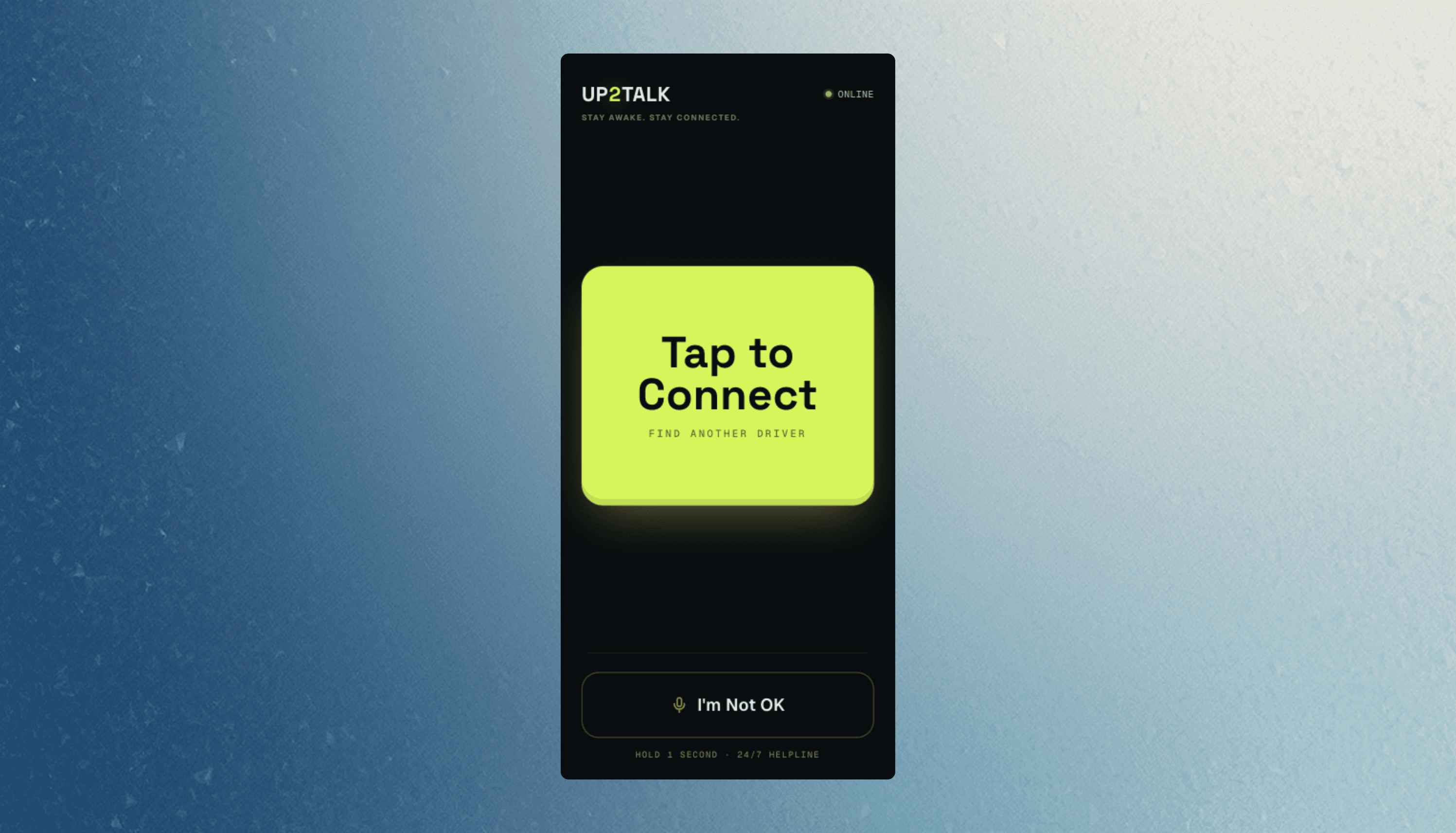
Up2Talk lets a driver tap once and be connected, by voice, to another driver who is also up to talk. There is no sign-up, no profile and no names. The whole thing is anonymous, so it feels less like social media and more like picking up a CB radio and finding a friendly voice.
The part that matters most is the “I’m not OK” button. A driver who is struggling holds it for a moment and it dials a real crisis helpline. Everything else falls away around those two simple actions: talk to someone, or get help.
The decisions that shaped it
A few calls did the heavy lifting.
Voice as the interface, not a screen. Drivers can’t be reading and tapping at the wheel. Building around voice isn’t a style choice, it’s the only safe way the app can work, and it shaped everything downstream.
Anonymous by design. No names, no profiles, no accounts. A driver taps to connect and is matched with the next available driver, with nothing personal shared either way. It lowers the bar to reaching out and keeps the focus on the conversation, not on who you are.
Crisis support as a first-class feature. The “I’m not OK” path isn’t buried in a menu. It’s a primary action, because for this audience that’s the feature that justifies the whole thing. You hold the button for a second before it dials, so a bump in the cab can never trigger it by accident.
Safety shaped every screen. For an app used behind the wheel, the design had to be glanceable. One action per screen, big high-contrast buttons, nothing to read or type, and a screen that stays awake during a call. The app even checks the microphone before connecting, so a driver with a broken mic is never matched and left in silence. These choices are what make it a product fleets can stand behind.
Foundations that don’t box him in. Marlon’s already thinking about adjacent markets like the RV and van life community. We built the core so a new audience is mostly a matter of branding and settings later, not a rebuild, without adding cost or scope to this phase.
The app installs straight to a driver’s phone like a normal app, with no app store needed, and is built to quietly reconnect if signal drops mid-call. Richer features for the trucking companies Marlon wants to sell into, like a fleet view, are mapped out as the next step rather than baked into this first version.
Where it stands
The core driver experience is built and working: anonymous voice connection and the “I’m not OK” helpline button. Fleet features and a fully native app are the next steps.